The Best Life Advice I’ve Ever Gotten – English with “SHOULD” สาธารณะ
ประเภท:
ลักษณะ:
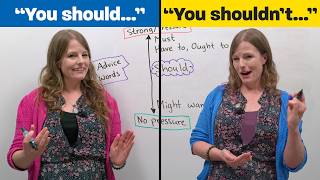
Learn how to give advice naturally in English with “should” and “shouldn’t”! In this lesson, I share some of the best life advice I’ve ever gotten, so you can hear “should” used in real sentences.
First, we look at advice words and how strong they are:
• Strong advice: *must, have to, ought to, need to*
• Soft advice: *might want to, could*
• In the middle: *should*
You’ll also learn how to pronounce *“should”* (the “l” is silent!) and why we use a base verb after it _(“You should take…”)._ Then I’ll give you my favorite pieces of life advice:
• You should take small steps, which can lead to big changes over time.
• You shouldn’t make big decisions when you’re hungry.
• You should have three people you can count on.
• You should stay curious and try new things.
• _and many more...!_
What is the best advice someone has given you? Write it in the comments. I’d love to read it!
When you finish the video, take the quiz at https://www.engvid.com/best-life-advice-english-should to practice *“should”* and *“shouldn’t”* and check your understanding.
Next: learn more ways to talk about advice! https://youtu.be/uJ4yvTzW_Xw
In this lesson:
0:00 Emmas Life Advice with "SHOULD"
2:08 You should take small steps, which can lead to big change.
4:04 You shouldnt make big decisions when youre hungry.
4:24 You should have 3 people you can count on.
5:28 You should stay curious and try new things.
5:48 You should try to be the best person you can be...
6:25 You should learn a second language.
7:37 You should pay attention to your posture...
8:38 You should avoid scams.
9:35 You should meet people of all different ages.
10:26 You should always remember you are human...
11:00 You should never believe its too late to change.
12:21 Conclusion
TRANSCRIPT:
In todays lesson, I am going to give you some of the best life advice Ive ever gotten. And to do this, Im going to use the word "should", and Im going to teach you about the word "should" and "shouldnt". So, before we get to the life advice, I just wanted to talk a little bit of grammar.
So, we have a lot of different words we use when we give advice. So, we can call these advice words. So, they are on a continuum, so some of the words are very strong when youre giving very strong advice, like your boss might tell you this, or maybe your teacher, or your parent, or the police. And then you might have some advice that is with no pressure, so it might be the advice your friends give you when they dont want to put pressure on you, but they have a suggestion. And then you have some advice thats kind of in the middle, and thats what "should" is. Its kind of a middle type of advice word, and its one I really like to use.
So, just to kind of show you some of the stronger words, we have "must". "You must do your homework." "You have to go to bed at 9pm." "You ought to study hard." "You need to do your taxes on time." So, these are all strong words where were giving advice.
Now, compare this to these words. Oh, "you might want to study tonight." "You could study tonight", so these are not so strong. Then we have in the middle "should". "You should study tonight." So, today Im going to give you life advice, and Ive decided to use the middle form, "should", to do this. So, were going to use "should" and "shouldnt", and Im going to teach you some different sentences and youre going to get to see the type of life advice I think is important. So lets go.
So, I have a lot of advice. A lot of this advice is from other people that I really like and live my life by. The first piece of advice is probably my favourite. "You should take small steps which can lead to big changes over time."
So, before we talk about this piece of advice, I want you to notice that I use the word "should", and the pronunciation is "should". I point that out because when you have an "l" and a "d", a lot of people start to try to pronounce the "l", theyll say "should", but no, just ignore the "l". We say "should". The other thing I wanted to point out is that after "should" we have a verb. […]
ต่อไป
เล่นอัตโนมัติ






14 ชั่วโมง