7 Ways to Say “NO” Politely in English สาธารณะ

ประเภท:
ลักษณะ:
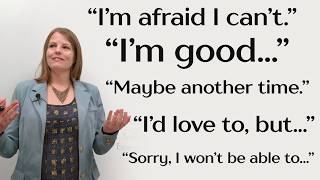
Saying “no” directly can sound rude or too strong in English. A friend invites you to a party, but you can’t go. What do you say? In this lesson, you’ll learn polite English phrases to refuse invitations, offers, and requests in a friendly way. I’ll show you an easy formula: kind start + “but” + reason. For example: “I’d love to, but I have to study.” We’ll cover common and very useful ways to say no including “I’m afraid I can’t”, “Maybe another time”, and even “I’m good.” Then we’ll practice together with everyday situations, so you can start using these phrases right away. https://www.engvid.com/how-to-say-no-politely-in-english/
Learn more English for real social situations!
https://youtu.be/IAPiv_WMdxU
https://youtu.be/8KMZeaPnj84
In this lesson:
0:00 How to say "no" politely in English
1:20 Id love to, but...
1:57 Thanks for asking, but...
2:28 That sounds great, but...
3:17 Im afraid I cant.
4:08 Sorry, I wont be able to...
5:03 Im good, but thanks.
5:46 Maybe another time.
6:36 Practice
TRANSCRIPT:
Imagine this, your friend invites you to a party, but you cant go. What do you say? Do you say, "No, nope, I cant." Or do you say something along the lines of, "Oh, Id love to, but I have to study." Well, the way to be polite is to say something like this. "No" itself can be a little bit strong and direct, so there are more polite or softer ways to say "no" in conversation.
My name is Emma, and today we are going to talk about a very important skill, and that is how to say "no" in English politely. So, were going to learn how to say "no" in English politely, and some different ways to do this. Im going to teach you some great expressions to help you to do this.
Here is a formula I really like for how to say "no" politely, especially when somebody asks you to go to an event or to do something with them. So, you can say what we call a kind start, "but", and a reason. So, Im going to give you some examples of this. "Id love to, but I have to study." Or you can have a different reason. "Id love to, but" - thats the night my grandmother is coming to visit - "Id love to, but I have to work." So, "Id love to" is a kind start. Its a way to say "no", but in a soft and indirect way. Okay. The "d" here means "would", so "I would love to, but", and then you give a reason why you cant do something.
Another example of a kind start is "thanks for asking". "Thanks for asking, but", and then, again, you give a reason. "Thanks for asking, but Im busy tonight." So, imagine somebody says, "Oh, do you want to go see a movie tonight?" "Oh, thanks for asking, but I already have plans. Im busy tonight." So, thats a way more polite way to say "no" than to just say, "Nope, cant go."
All right, heres another kind start. "That sounds great, but I already have plans." So, again, you can see, just you start off with something nice, these are all nice starts, and I would recommend maybe memorizing one or two of them. Theyre very, very useful in conversation. Once you learn a kind start, you can use these all the time in many different contexts.
And then we have the "but" and the "reason". So, now lets look at other polite ways to say "no". So, sometimes you need to say "no" a little bit more directly and right away. So, here are some polite ways to say "no" that are not as soft as the previous examples, but are very useful. So, for example, the first one is "Im afraid I cant", and then you give a reason. So, when you say "Im afraid", you might think, "Oh, were talking about fear now, were talking about ghosts, insects, spiders." No, we often use the expression "Im afraid" when were saying "no" for something. "Im afraid I cant", and then you give a reason. So, its polite, its formal, so you would use this more in a professional setting, less likely to use this with friends. And heres an example. "Im afraid I cant attend the meeting today. Im having lunch with a client." So, again, when you use "Im afraid I cant", its always good to have a reason why you cant do something.
Another way to say "no" in a polite, formal way is "Sorry, I wont be able to." So, its softer than "I cant". You can say "I cant" as well, depending on context, but this is a little bit softer. So, heres an example. "I wont be able to do it today. Im sorry. I wont be able to finish this project tonight. Im sorry." "Sorry, I wont be able to have dinner with you tonight. I have too much work to do." So, those are examples of how to say "no" politely, but also directly.
Now, lets look at some other examples. So, these ways to say "no" are the types of "no"s you would say to a friend or in a very casual situation. So, the first one is a great example. "Im good, but thanks." A lot of people who are learning English get confused by this one, because they see "Im good", they dont realize that means "no". So, if somebody says, for example, "Do you want another drink? Im good, but thanks." […]
Learn more English for real social situations!
https://youtu.be/IAPiv_WMdxU
https://youtu.be/8KMZeaPnj84
In this lesson:
0:00 How to say "no" politely in English
1:20 Id love to, but...
1:57 Thanks for asking, but...
2:28 That sounds great, but...
3:17 Im afraid I cant.
4:08 Sorry, I wont be able to...
5:03 Im good, but thanks.
5:46 Maybe another time.
6:36 Practice
TRANSCRIPT:
Imagine this, your friend invites you to a party, but you cant go. What do you say? Do you say, "No, nope, I cant." Or do you say something along the lines of, "Oh, Id love to, but I have to study." Well, the way to be polite is to say something like this. "No" itself can be a little bit strong and direct, so there are more polite or softer ways to say "no" in conversation.
My name is Emma, and today we are going to talk about a very important skill, and that is how to say "no" in English politely. So, were going to learn how to say "no" in English politely, and some different ways to do this. Im going to teach you some great expressions to help you to do this.
Here is a formula I really like for how to say "no" politely, especially when somebody asks you to go to an event or to do something with them. So, you can say what we call a kind start, "but", and a reason. So, Im going to give you some examples of this. "Id love to, but I have to study." Or you can have a different reason. "Id love to, but" - thats the night my grandmother is coming to visit - "Id love to, but I have to work." So, "Id love to" is a kind start. Its a way to say "no", but in a soft and indirect way. Okay. The "d" here means "would", so "I would love to, but", and then you give a reason why you cant do something.
Another example of a kind start is "thanks for asking". "Thanks for asking, but", and then, again, you give a reason. "Thanks for asking, but Im busy tonight." So, imagine somebody says, "Oh, do you want to go see a movie tonight?" "Oh, thanks for asking, but I already have plans. Im busy tonight." So, thats a way more polite way to say "no" than to just say, "Nope, cant go."
All right, heres another kind start. "That sounds great, but I already have plans." So, again, you can see, just you start off with something nice, these are all nice starts, and I would recommend maybe memorizing one or two of them. Theyre very, very useful in conversation. Once you learn a kind start, you can use these all the time in many different contexts.
And then we have the "but" and the "reason". So, now lets look at other polite ways to say "no". So, sometimes you need to say "no" a little bit more directly and right away. So, here are some polite ways to say "no" that are not as soft as the previous examples, but are very useful. So, for example, the first one is "Im afraid I cant", and then you give a reason. So, when you say "Im afraid", you might think, "Oh, were talking about fear now, were talking about ghosts, insects, spiders." No, we often use the expression "Im afraid" when were saying "no" for something. "Im afraid I cant", and then you give a reason. So, its polite, its formal, so you would use this more in a professional setting, less likely to use this with friends. And heres an example. "Im afraid I cant attend the meeting today. Im having lunch with a client." So, again, when you use "Im afraid I cant", its always good to have a reason why you cant do something.
Another way to say "no" in a polite, formal way is "Sorry, I wont be able to." So, its softer than "I cant". You can say "I cant" as well, depending on context, but this is a little bit softer. So, heres an example. "I wont be able to do it today. Im sorry. I wont be able to finish this project tonight. Im sorry." "Sorry, I wont be able to have dinner with you tonight. I have too much work to do." So, those are examples of how to say "no" politely, but also directly.
Now, lets look at some other examples. So, these ways to say "no" are the types of "no"s you would say to a friend or in a very casual situation. So, the first one is a great example. "Im good, but thanks." A lot of people who are learning English get confused by this one, because they see "Im good", they dont realize that means "no". So, if somebody says, for example, "Do you want another drink? Im good, but thanks." […]
ต่อไป
เล่นอัตโนมัติ









14 ชั่วโมง